My pastors shared a video with me once from Monk Shen Yu, who said, “Grief is love that has changed its shape.”
I didn’t understand that at first. Grief doesn’t feel like love. It feels heavy. Disorienting. Sometimes hollow, sometimes overwhelming. It feels like something has been taken—not transformed. But over time, I’ve started to understand what he meant. Love doesn’t disappear. It persists—but it changes form. It becomes something quieter. Less recognizable. But still undeniably there.
In medicine, I’ve come to realize that this is not unique to grief. Voice can change shape, too.
I think about a patient I cared for not long ago. They were kind, gracious, and quietly guarded. Every day, they thanked the team. Every day, we focused on what we were trained to see: oxygen requirements, imaging, medications, trajectory. And yet, there was a distance I couldn’t explain.
It wasn’t until later—through a passing comment, almost an aside—that I realized how much of their life we had never touched. Identity. Relationships. Who mattered most at the bedside. What had shaped their health long before they reached the hospital. Not because it wasn’t important, but because we never asked.
That realization stayed with me. But it wasn’t the first time I had seen what happens when something essential changes shape and we fail to recognize it.
I met my friend—whom I will call David in this piece to honor the request for privacy made by his biological family—long before he became my patient. At a time in my life when things felt uncertain, David was the one who stepped in. He was a pillar of his community, a seasoned leader in the emergency medical services world, and a dedicated mentor. He was the kind of person who quietly shaped the lives around him through small, consistent acts of service. His door was always open. People came to him because they knew they would be met with patience, humor, and kindness.
And his laugh was immediate, unmistakable—the kind of laugh that filled a room before you even processed the joke. Often a terrible joke. But that never mattered. The laugh came anyway, full and unguarded, and it made everything around him feel lighter.
He was my friend first. Then, after his diagnosis, he became my patient.
David lived with amyotrophic lateral sclerosis (ALS). And like so many patients with this disease, he lost things slowly, then all at once. First, the small things—subtle weakness, fatigue, the quiet betrayals of muscle. Then, speech. Then, breath. There is a particular kind of silence that comes with ALS. Not the kind that feels peaceful. The kind that feels unfinished.
As the ALS progressed, his laugh changed. It softened, shortened, and became something he had to work for. The sound was different. Quieter. Sometimes fragmented. But it was still his. And that was the thing that stayed with me most—not what the disease took, but what it could not. Because even as the sound changed, the meaning didn’t. The humor was still there. The presence was still there. He was still David.
I grieved him deeply. In ways that felt heavy and disorienting, the kind of grief that doesn’t move in straight lines or resolve cleanly. But over time, I began to understand something I hadn’t before. Grief isn’t the absence of love. It’s what love becomes when it no longer has a place to go. It changes shape. Just like his voice did. And just like his voice—though altered—it still carried who he was. That love remains, even now, shaped differently but still undeniably there.
That lesson has stayed with me in ways I didn’t expect. Because in pulmonary and critical care medicine, we often meet patients at the very moment when something essential is already beginning to change shape.
A voice becomes quieter. A story becomes harder to tell. A person becomes, in our documentation, a set of data points—unless we ask before that happens.
We are trained to ask detailed, precise questions. We ask about smoking history down to the pack-year. We ask about exposures, travel, occupational risks. We pride ourselves on thoroughness. But there are gaps in our history-taking that are quieter—and just as consequential.
We identify a next of kin. But we don’t always ask who the patient trusts.
In the LGBTQIA+ community, the word "family" carries a weight that isn’t always captured on an emergency contact form. For many, there is a sharp distinction between biological family and chosen family. Biological kin represent our history, but for many queer people, those ties are fraught with the ghosts of rejection or conditional acceptance.
Chosen family, however, is the sanctuary we build by hand. It is the circle of friends, partners, and mentors who saw us when we were invisible and chose to stay. In the ICU, if we only look for a legal surname or a blood relative, we risk barring the very people who hold the patient’s spirit together. We risk leaving the patient alone in the silence, separated from the only people who truly know the "shape" of their love.
I often think about what would have happened if I had not been David’s physician during those final, critical days. Had we followed the standard protocol of identifying only a legal next of kin, we would have contacted his biological family and stopped there. His chosen family—the people who saw him, cared for him, and held his spirit together—would have been left on the outside, unaware that the person who meant the most to them was slipping away. Instead, because I knew the reality of his life, we ensured his chosen family was at his bedside. That day, the room was filled with double the number of people who loved him, all there to say goodbye. That was the difference between a tragedy of omission and a final act of dignity.
So, how do we begin to bridge this? We must move beyond the static, binary limitations of the emergency contact form. The solution lies in a simple, intentional pivot in our clinical practice: We must normalize asking, “Who is your chosen family?” and “Who should we call if you cannot speak for yourself?” as part of our standard admission. It is not an invasive question; it is an act of clinical safety. When we explicitly ask, we empower the patient to name their sanctuary, removing the burden of disclosure from them and placing the responsibility of recognition on us. By integrating this into our electronic medical record templates, rounding checklists, and bedside handoffs, we stop treating “family” as a legal status and start treating it as a clinical priority.
For LGBTQIA+ patients, these gaps are not theoretical. They are lived. They shape whether someone feels safe enough to speak openly, whether they delay care, and whether they are fully seen in moments when it matters most. And in critical illness—when communication is reduced to gestures, brief words, or silence altogether—the cost of not knowing who someone is becomes impossible to ignore.
Because by then, something essential has already changed shape. A voice becomes a gesture. A story becomes fragments. A life becomes something we try to reconstruct, rather than something we truly understood.
David taught me that identity does not disappear when a voice is lost. But our ability to recognize it depends on whether we were paying attention before it changed.
Grief is love that has changed its shape. And in medicine, we see this everywhere—in voices that fade, in bodies that fail, in lives that narrow but do not lose their meaning. Our job is not just to measure what remains. It is to recognize what persists.
To ask before the moment passes:
Who are you?
Who matters to you?
What should we know about you to take better care of you?
Because if we wait, if we assume, if we stay silent, we won’t just miss the answer, we’ll miss the person.
Because even when a voice changes shape, the person behind it is still there, waiting to be known.
Today, I find myself carrying David’s story into medical education via CHEST through my tabletop-inspired educational tool, Dungeons & Dyspnea™. As I design new ways to teach pulmonary physiology, incorporating the very pulmonary function tests that once charted the decline of David’s own breath, I am reminded that education is a form of advocacy. I use his clinical data not just to illustrate the mechanics of neuromuscular disease but also to teach my students that behind every set of flow-volume loops is a person with a chosen family, a unique voice, and a story that deserves to be heard.
I hope that by sharing David with them, I am training a generation that won't wait for a patient to lose their voice before they think to ask who is holding their hand. That is how I keep his laugh alive. That is how I make sure that, even now, the shape of my love for him continues to do some good in the world.
To learn more about how Dr. Nutting is integrating narrative and clinical education through Dungeons & Dyspnea™, subscribe to his newsletter.
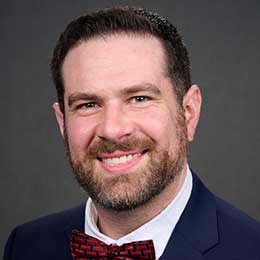
Andrew (Andy) C. Nutting, DOAndrew (Andy) C. Nutting, DO, is a pulmonary and critical care physician who recently joined the medical staff at Cleveland Clinic. He completed his fellowship at the University of Mississippi Medical Center and residency at Baptist Health Brookwood Hospital, and he earned his medical degree from Lincoln Memorial University-DeBusk College of Osteopathic Medicine. His clinical interests include interstitial lung disease, neuromuscular respiratory disease, rare pulmonary diseases, and LGBTQIA+ medicine. With a background in operations coordination at the Walt Disney Company, Dr. Nutting brings a unique focus on patient-centered communication and the longitudinal care of patients with complex conditions to his practice.
JOIN THE LGBTQ+ AT CHEST INTEREST GROUP »