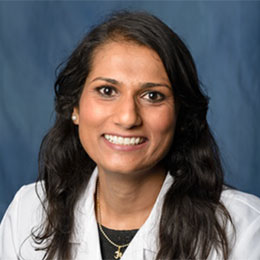
Divya Patel, DOIn 2019, pulmonologist and critical care physician Divya Patel, DO, attended the CHEST Annual Meeting in New Orleans. At the meeting, CHEST leader Doreen Addrizzo-Harris, MD, FCCP, shared details on the John R. Addrizzo, MD, FCCP, Research Grant in Sarcoidosis, named for her father.
“What she talked about in her presentation was that her dad just really cared about patients with sarcoidosis,” Dr. Patel recalled.
People with sarcoidosis develop granulomas (or clusters of cells) most commonly in the lungs or lymph nodes, as well as in other organs. It can lead to a variety of symptoms, including shortness of breath and coughing, when it’s present in the lungs. Sarcoidosis is a rare disease, affecting more Black people than White people and more women than men.
“It’s not a disease where there is a lot of funding for people starting out in that field,” Dr. Patel said. (Other rare diseases do get plenty of research support, she noted.) That matters, because if there aren’t grants or access to funding, the pipeline for future sarcoidosis investigators dries up, Dr. Patel added.
So, it’s meaningful that CHEST offered this grant. For Dr. Patel, who’d been applying for grants for quite a while, receiving it was gratifying on a number of levels. “It was really nice to get that validation.”
The plan: Studying genetic differences
There are a few treatment options for sarcoidosis, including steroids and methotrexate. Since steroids have a lot of side effects (including an increased infection risk, mood changes, weight gain, elevated blood sugar, and increased BP), clinicians and patients often seek to avoid them, and methotrexate is considered a first-line steroid-sparing treatment option, Dr. Patel said.
The problem: The medication is effective for some, but not all, patients, which leads to months of limbo for patients who take methotrexate while waiting to determine if it eases symptoms.
“I applied for the grant to do a pilot project where I investigated genetic differences between patients who responded or didn’t respond to methotrexate," Dr. Patel said.
Working past obstacles
The original plan was to use the grant funding to get patients’ consent to participate in the study when they visited their clinic, then obtain and analyze a blood sample, Dr. Patel recalled.
But then COVID-19 arrived. “Our clinic went from in-person to telemedicine,” Dr. Patel said. Plus, the pandemic shifted priorities: “I was working a lot in the ICU, and clinics [and anything in] the outpatient world took a backseat.”
While patient recruitment was limited due to the pandemic, she worked with the National Jewish Health Group to get data from their biorepository of patients with sarcoidosis. That was helpful but not necessarily a time-saver, since it meant wrangling regulatory and data-sharing requirements. After the pandemic, Dr. Patel was able to restart the study.
The impact—and what’s next
Now, Dr. Patel is working with a pharmacogeneticist to sift through the data and uncover any potential genetic differences between patients who respond to the medication and those who do not. “We have already looked at the characteristics of the patients that we included in the trial, so we have an idea of the demographics of the people that responded and didn't respond,” Dr. Patel said. Once that information and the genetic data are fully analyzed, the next step will be to publish the findings.
For patients with this incurable condition, gaining this knowledge could have a powerful effect.
Right now, if Dr. Patel has a patient with lung sarcoidosis who she believes will benefit from methotrexate, she prescribes the medication. Then the waiting game begins. “I wait anywhere between three to six months before I know whether it's helping them or not,” Dr. Patel said, looking to see if symptoms, lung function, and lung imaging improve. For patients—particularly ones struggling to breathe—this is a long wait time. Plus, some patients may experience the potential side effects of methotrexate without reaping any benefits during this period.
If Dr. Patel’s research uncovers a genetic distinction that predicts the medication’s efficacy, the treatment protocol can be adjusted to include genetic testing as a first step before the prescription pad comes out. Clinicians will be able to use these genetic results to inform their medication choice.
“If we can tell patients ahead of time [that methotrexate] will work for you, or you might have a problem with this medication, it would be really great,” Dr. Patel said.
Even as Dr. Patel and her team continue their analysis on the path to publication, there have already been personal benefits to receiving the grant from CHEST. “After I received the grant, I was able to include that in my promotion packet for associate professor,” Dr. Patel noted. She was also able to meet with a mathematician at the University of Florida; together, they’re working on mathematical modeling techniques that might help predict patients’ responses to medication. “Getting the CHEST grant helped push some of those relationships along,” Dr. Patel said.
Plus, receiving the grant from CHEST—and performing research—helps spur more studies around a disease that might not get a lot of attention. “Once I’m able to share the data, I’m hoping that helps to highlight an area of need for patients with sarcoidosis.” Ultimately, more clinicians and scientists investigating the response of patients with sarcoidosis to various treatment paths is important and beneficial, Dr. Patel said.