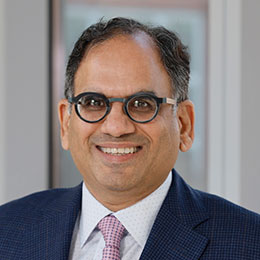
Maneesh Bhargava, MBBS, PhDDiagnosing sarcoidosis isn’t a straightforward process. The disease doesn’t have its own test, which means clinicians need to rule everything else out first for the approximately 1.9 million people globally who have it.
Plus, when someone has a diagnosis, there’s no way to tell if they have a treatable disease—or if they’re in for a tougher road ahead.
Maneesh Bhargava, MBBS, PhD, is working to change that. He’s looking to create a test for sarcoidosis, thanks in part to a John R. Addrizzo, MD, FCCP, Research Grant in Sarcoidosis from CHEST, which he received in 2021.
Dr. Bhargava, who is a professor of internal medicine and an assistant director for translational research, pulmonary, and critical care medicine at The Ohio State University, is examining proteins involved with inflammation in lung sarcoidosis by collecting blood samples from patients to “measure and quantify hundreds of proteins simultaneously," he said. The research team is using proteomics, which allows for large-scale protein analysis, “specifically looking at inflammatory proteins and how they can be leveraged to help diagnose and predict the course of the disease.”
Through the CHEST-funded work and a complementary project, his team has been identifying inflammatory proteins and metabolic proteins. “If you combine proteins that do different things, then you can build models that perform better to both predict presence of sarcoidosis and predict the disease progression,” he said.
The team currently has a paper under review about one such model that, when compared with blood from people who are healthy, can predict with high accuracy which samples are from people with sarcoidosis. “The multiprotein patterns perform better than inflammation-only or metabolism-only panels,” he said.
Tests for sarcoidosis are vital because there’s a clear clinical need, he added. “We struggle, on a day-to-day basis, when we treat patients.” Having to rule out every possible cause of inflammation costs patients time, and it can be expensive and frustrating.
People with sarcoidosis that affects high-risk organs like the heart and brain, or multisystem disease, also have a poorer quality of life and shorter lifespans. Knowing who is more likely to have worse outcomes means they can also be enrolled in clinical trials, which would make the trials less expensive because researchers can find the best candidates. “It would help us as a community get nimble and perform the work that the community desperately needs,” he said.
Dr. Bhargava applied for the CHEST grant because he saw this project as matching the organization’s mission. The team began collecting blood and other data and specimens in 2015 and 2016, so “we had a repository available to do the work that we were promising, and the timing was perfect,” he said.
The team has also received a National Institutes of Health grant for a project using data generated by the CHEST-funded work to look at “a bigger group of patients to determine why some have progression of lung sarcoidosis,” he said. They’re also looking to develop, validate, and confirm a model based on plasma proteins to predict disease course at or near diagnosis.
He keeps going because of his patients, he added. When they ask if they have sarcoidosis, he can’t give them a certain answer—or if they are already diagnosed, he can’t definitively tell them whether “it will get better or worse or what will happen to them,” he said.
A test—especially one that would be cheap and easy to do so patients could get a diagnosis even outside of specialized centers—would be a game changer.
“It was just the right time to combine a need and the technology that can answer some of these challenging questions,” he said.